May 28, 2026 | Chris Lema
Knowledge Isn't Stored. It's Built.
Why storage is the wrong question for knowledge, and how decomposing content into a graph builds answers no document ever held. The MCode Coach story.
When people talk about knowledge, the question I hear a lot is "Where are you storing it?" and that's become a serious question because we all said either docs or databases before AI. But now there are people talking about RAG, Graphs, GraphRAGs and more.
And I'm going to do that thing right now that will make you think this is from AI, but I've been using contrast for two decades, so I don't care.
The question "Where are you storing knowledge?" is the wrong question. The right question for me has always been, "Where does knowledge come from?"
And I know, we're likely to think the answer is the same - docs and databases. But I don't think so. That's where data comes from. Those artifacts are the exact places where knowledge goes to die. But that's not where it's born from.
I'm going to tell you about the work I've been doing recently, and it's going to use the word Graph, and of course this is about AI, but my overall push today is to make something super clear that works whether you're into AI or not.
Also, I'll just say up front, this was not possible, for me, before AI.
The MCode Coach
So I work with our team at Motivation Code. And they're some seriously smart people. Together, we've produced tons of content over the last few years. Valuable content.
Recently we had a client ask about how to get an MCode Coach into their Claude interface. Like most of our clients, they get our premium report, and they're thrilled. But it's long. So they drop it into Claude and then ask it question.
Only Claude doesn't have all the knowledge we do. It only has what's in their specific report.
So that was the ask.
And I started thinking about how we'd do it.
The Likely Candidates Don't Do What I Want
You know what I'm going to say. The options were pretty simple - an indexed data store, or a vector database / RAG. Both of those options help solve the "discovery" problem. Find the relevant content and surface it.
But when we're talking about letting a client ask any kind of motivation question, search and discoverability won't do the trick.
What I need is a way to create a great answer.
But that word, "create," is just a path towards AI slop that no one will value. Plus, when your IP is scientific, you need to make sure that you're not making up stuff that isn't true or anchored in our data.
The Right Question
So I stopped thinking about "Where do I store this knowledge?" and I started asking, "How will this knowledge get created?"
I ask it this way because when I'm giving a talk, and I get a question I've never heard before, it doesn't stop me. I still construct a new answer. But I build it from first principles of our content, knowledge and data.
How did that answer get created? Because I'm able, and our whole team is - this isn't just me, to assemble the valuable bits into a new answer.
Where does knowledge get created? It's not a where. It's not a place. It's a "how" question.
How does knowledge get created? By building new connections. By navigating new paths across the graph. That's all during the assembly of the graph. But you'll see, it's also at runtime.
Assembling a Knowledge Graph
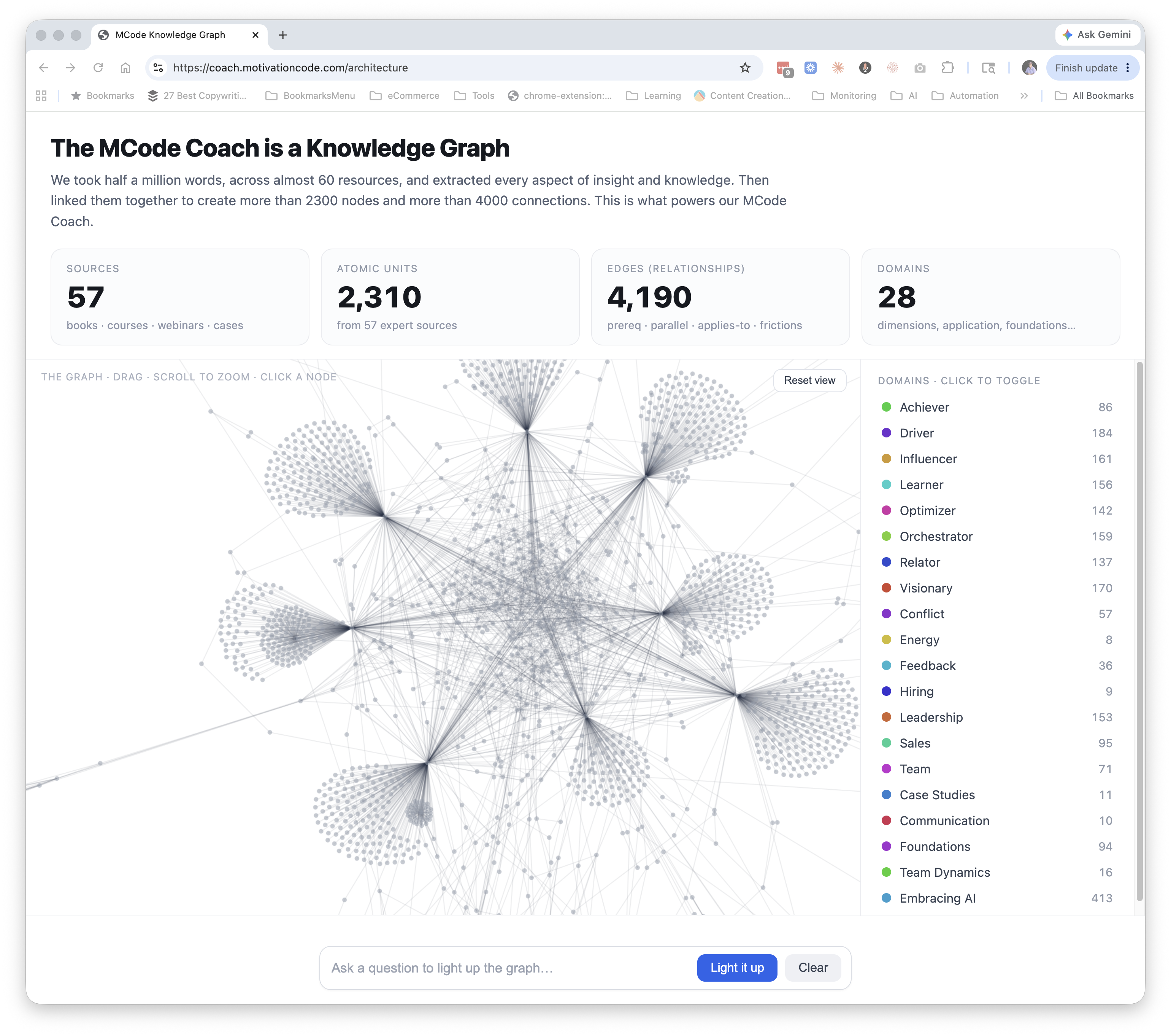
When you think about a knowledge graph, you've seen the pictures. It's a ton of dots (atoms) and lots of lines (edges) connecting them. And there's a tremendous value in the edges. It's not just the content of the node.
In the early years of eLearning, people would record 1 hour lessons. But we quickly realized, that would make that content really hard to be portable. It's too much. You need to break it into small, tiny, little bits of insights.
When Scott Kelby did this (KelbyOne.com), it was incredible. 3-5 minute lessons instead of 60 minute lessons meant you could also take that one little lesson and put it into another course.
But it's more than that. When you look at the nodes and edges, you might notice that some of the nodes aren't connected. And you think, "but they should be." And guess what you just did? You created new knowledge! That move — noticing the relationship nobody else connected — is exactly what pattern recognition looks like for consultants.
Proximity in a RAG doesn't say anything about two nodes. But an edge connecting two nodes does give meaning. And proximity without an edge could be a hint that maybe there's something there.
Years after my first interactions with Kelby's team, I met another famous online educator. They were creating a new course every time a customer showed up asking for something. No shocker, they had 40 courses in no time.
Now imagine the world of AI and chatbots and agents and all that good stuff. How many custom GPTs do you want to create? One per customer? One per topic? A hiring one? A team conflict one?
Or do you want to deconstruct all your knowledge into little nodes - extracting all your insights from large content sources - and assemble them via edges into a knowledge graph that can handle your own investigation into all different kinds of relationships between them. But also make the graph available to an agent, or engine?
Our MCode Coach is a Knowledge Graph
So I built our own knowledge graph. Took almost 60 sources and broke them down into 2300 nodes/atoms of insights. Then tagged and categorized them.
Then I would define different kinds of relationships. And here's what AI made possible. I was articulating meaning but AI was able to navigate across the entire graph and connect the dots. I still drove meaning. AI drove scale. And the result? Over four thousand connections.
Then I made it available via MCP to solutions like Claude.
You can't purchase the MCP access yet, but you can see the graph here: https://coach.motivationcode.com/architecture
You can even ask it a question and see the nodes that light up.
And here is where you might get surprised. There are some answers in there that we've never dreamed of before. Because there are paths across the traversal of the graph, that we had never done before.
And the result is that today as I was asking questions, I got all the answers I expected. And then one more. A conclusion that was grounded in science but one I'd never even considered. I'd never connected the dots like that before.
A story. An insight. A bite-sized way to help.
Get every article directly in your inbox every other day.
I won't send you spam. And I won't sell your name. Unsubscribe at any time.
About the Author
Chris Lema has spent twenty-five years in tech leadership, product development, and coaching. He builds AI-powered tools that help experts package what they know, build authority, and create programs people pay for. He writes about AI, leadership, and motivation.