
Most executives hear about Claude and think “cooler search engine.”
Ask it questions. Get answers. Maybe it writes emails faster.
That's like buying a Tesla and only using it to charge your phone.
Last week I pointed Claude Cowork at a folder with 400+ executive motivation reports. I asked it to do something no search engine can do: find patterns I didn't know existed.
What happened next would have taken a data scientist several days. Claude did it in minutes.
What Claude Cowork Actually Is
Anthropic recently released Claude Cowork, built specifically for business use. Not sure if it's fantastic? I'll tell you my experience, but you don't have to trust me. Because it's discussed with Claude Code, and most folks don't code, they ignore it.
They're missing the point entirely.
Claude Cowork brings all the power of Claude, with a recursion loop, for practical business challenges. It analyzes. It synthesizes. It discovers patterns across datasets you'd never have time to review manually.
Think about it less like a search engine and more like hiring a brilliant analyst who reads everything instantly, never gets tired, and spots connections humans miss.
Let me show you what I mean.
The Experiment
I had a folder on my desktop with over 400 MCode reports. MCode is an assessment that measures what actually motivates leaders, not what they say motivates them, but what their behavior reveals about their underlying drives.
Each report is several pages. Reading all 400+ would take weeks. Extracting consistent data from each would take days. Finding patterns across the entire dataset? That's a data science project.
I pointed Claude Cowork at the folder and said: “Pull the key motivation data from all of these into a single spreadsheet.”
A human doing this carefully? Several hours minimum, probably a full day.
Claude did it in minutes.
But here's where it gets interesting.
The Real Capability
Extracting data is useful. Pattern discovery is transformational.
I looked at the spreadsheet Claude created and asked: “Review this data. Find 5-10 patterns of leader types. Tell me what clusters emerge.”
This is the ask you'd make of a data scientist. Cluster analysis. Pattern recognition. Finding structure in noise.
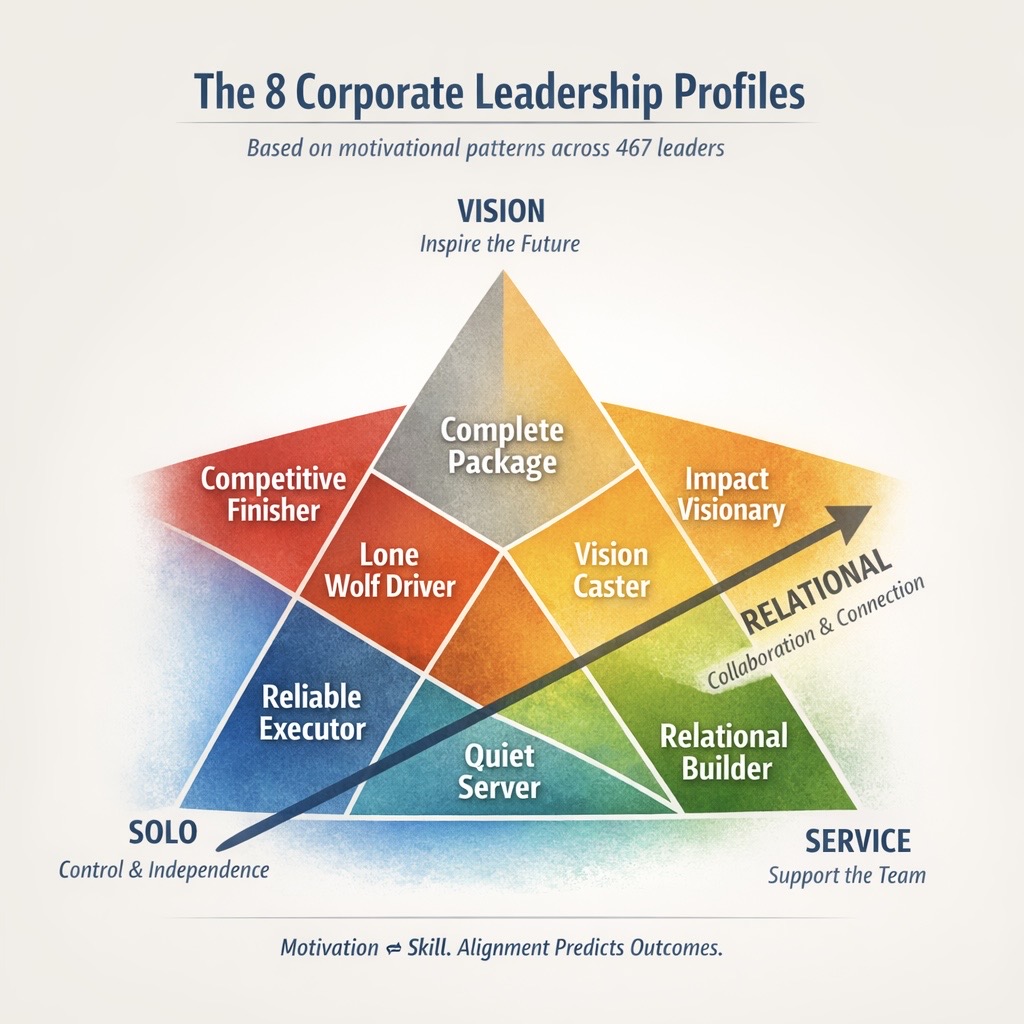
Claude found eight distinct executive profiles and three fundamental tensions that differentiate them.
Not patterns I told it to look for. Patterns it discovered.
What It Found
The three tensions that emerged explain something I've seen but never articulated this way:
Achievement vs. Service. Some executives are driven by personal excellence and competition. Others derive energy from helping people and building teams. Same company, completely different motivation engines.
Vision vs. Execution. Some executives see possibilities and cast direction. Others ensure things get done correctly. The visionary CEO and the operational COO aren't just different roles. They're different motivation patterns.
Solo vs. Relational. Some executives want to be central and in control. Others derive energy from connection and influence through relationships.
From these tensions, Claude identified eight distinct profiles:
- The Quiet Server (6%): High service, low ambition signals
- The Complete Package (20%): Elevated across everything
- The Competitive Finisher (14%): Achievement without service orientation
- The Impact Visionary (5%): Vision without follow-through energy
- The Reliable Executor (11%): Execution without vision
- The Lone Wolf Driver (8%): Challenge without collaboration
- The Vision Caster (13%): Inspiration without attention to detail
- The Relational Builder (23%): Team and establishment focused
I didn't tell Claude these categories existed. It found them by analyzing 467 data points and clustering by pattern.
That's analysis.
Why I Don't Have a Data Scientist Anymore
In my last several jobs, I had dedicated data scientists on staff. Smart people who could take messy data and find meaning in it.
I don't anymore.
My Claude subscription does it all for me.
That's not an exaggeration. The MCode analysis, pulling structured data from 400+ reports, finding clusters, identifying the three underlying tensions, that's exactly the kind of project I would have handed to a data scientist. It would have taken days, maybe a week when you factor in back-and-forth on the approach.
Claude did it while I watched.
I'm not saying data scientists are obsolete. Complex statistical modeling, production data pipelines, that's still specialized work. But the everyday analytical heavy lifting? The “help me make sense of this pile of information” work? That's Claude Cowork now.
What This Means for You
Here's the question worth sitting with: What's hiding in your data?
Every executive has folders full of reports, assessments, customer feedback, market research, competitive analysis. Information that sits there because no one has time to synthesize it all.
Claude Cowork changes that equation.
The reports you've been meaning to read? Point Claude at them and ask for the synthesis.
The customer feedback you've collected for two years? Ask Claude to find the patterns you've missed.
The competitive intelligence scattered across fifty documents? Ask Claude to build you a consolidated view.
This isn't about asking better questions. It's about having a tool that can analyze at a scale and speed that was previously impossible without a dedicated team.
The Shift
Most executives are still in “search engine” mode with AI. Type a question, get an answer.
Claude Cowork is built for something different. Give it a dataset. Ask it to find what you don't know. Let it do the analytical work that used to require specialists and time you didn't have.
The 400 MCode reports took me nowhere near the time it would have taken before. But more importantly, I got insights I wouldn't have found manually, eight leadership patterns that emerged from the data itself.
That's the capability most executives haven't discovered yet.
The question isn't whether Claude can help you. It's what you're not asking it to do.